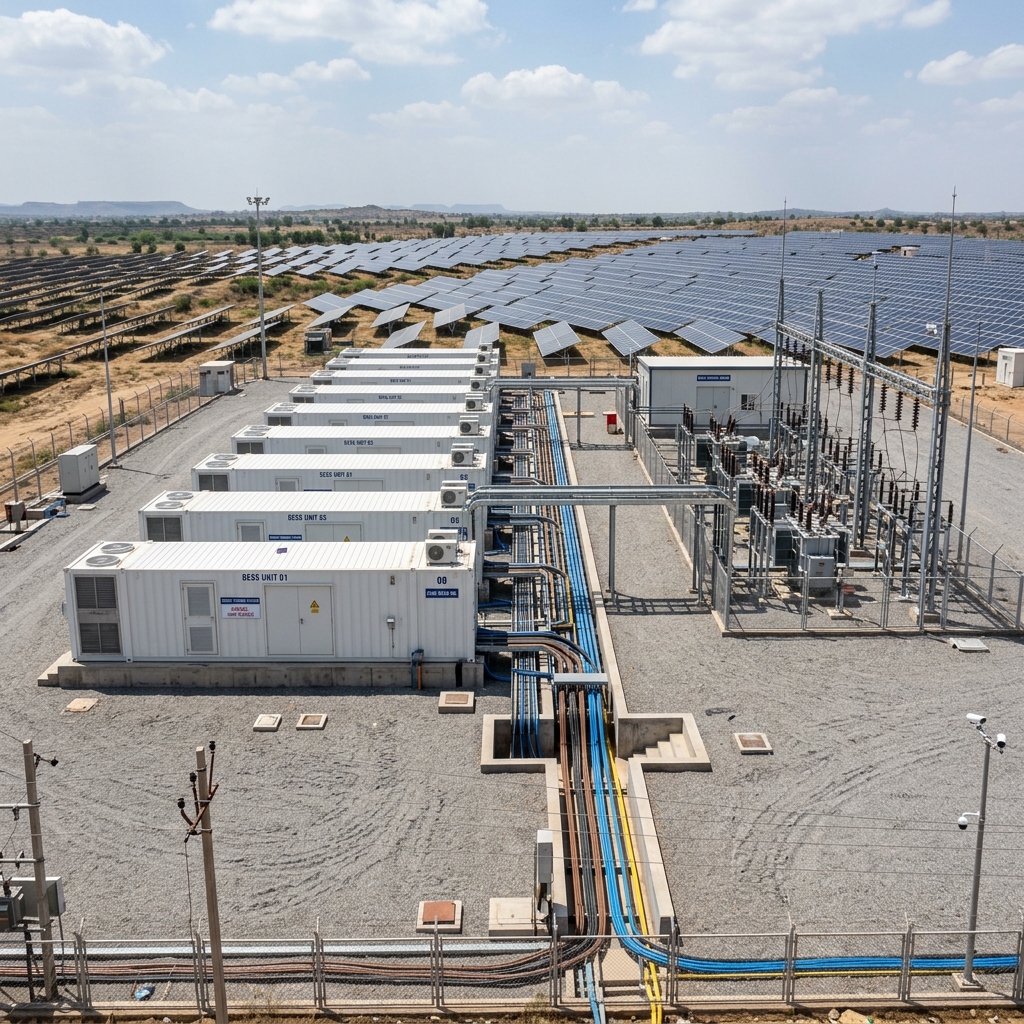
# Maharashtra Solar Projects: Why BESS Is Becoming Mandatory in 2026
Maharashtra is entering a new phase of renewable energy development where solar power and battery energy storage are becoming increasingly important together. Under the Maharashtra Renewable Energy & Energy Storage Policy 2025–26 to 2035–36, minimum energy-storage requirements have been introduced for certain new renewable-energy projects above the applicable capacity threshold.
For solar developers, EPC companies, commercial establishments and industrial consumers, this means Battery Energy Storage Systems (BESS) need to be considered much earlier during project planning and system design.
## Is BESS Mandatory with Solar in Maharashtra?
The Maharashtra Renewable Energy & Energy Storage Policy introduces minimum energy-storage requirements for certain new grid-interactive renewable-energy projects above 100 kW, subject to the applicable project category, regulations and notifications.
Under the initial framework, the minimum storage requirement is based on 50% of the renewable-energy project capacity with a storage duration of 2 hours.
For example, if a qualifying solar project has a capacity of 1 MW, the requirement can be calculated as:
Solar capacity: 1,000 kW
Minimum BESS power capacity: 500 kW
Storage duration: 2 hours
Required energy storage capacity: 500 kW × 2 hours = 1,000 kWh or 1 MWh
This makes BESS an important part of the technical and financial planning of new solar projects in Maharashtra.
## Why Is Maharashtra Introducing BESS with Solar?
Solar energy is a clean and cost-effective source of electricity, but solar generation is naturally dependent on sunlight. Solar panels generate electricity mainly during daylight hours, while commercial and industrial electricity demand can continue during the evening.
Battery Energy Storage Systems help solve this limitation by storing electricity when solar generation is available and supplying that stored energy when required.
A properly designed solar-plus-storage system can help businesses:
• Store excess solar energy
• Use renewable energy beyond daylight hours
• Improve utilization of solar generation
• Reduce dependence on grid electricity during selected periods
• Improve energy management
• Support better integration of renewable energy with the grid
This is why solar and BESS are increasingly being considered as a combined energy solution.
## What Is BESS?
BESS stands for Battery Energy Storage System.
A BESS is not simply a large battery. It is an integrated system consisting of batteries, Battery Management Systems, Power Conversion Systems, Energy Management Systems, protection equipment, thermal management and safety systems.
The battery stores electrical energy, while the PCS controls the conversion between AC and DC power. The BMS monitors the battery's operating condition, and the EMS controls when the battery should charge or discharge.
For large commercial and industrial solar projects, proper BESS design is therefore essential for performance, safety and long-term reliability.
## How Much BESS Is Required for a 1 MW Solar Project?
For a qualifying 1 MW renewable-energy project under the initial 50% storage and 2-hour framework, the calculation is:
1 MW solar capacity = 1,000 kW
50% storage power capacity = 500 kW
Storage duration = 2 hours
BESS energy capacity = 500 kW × 2 hours
BESS energy capacity = 1,000 kWh
Therefore, the indicative requirement is a 500 kW BESS with approximately 1 MWh of energy-storage capacity.
However, the final battery system should not be selected only by this simple calculation. Designers also need to consider usable battery capacity, depth of discharge, round-trip efficiency, battery degradation, operating temperature, PCS efficiency and the applicable grid requirements.
## What Does This Mean for Solar EPC Companies?
The introduction of BESS requirements changes the way solar EPC companies need to approach project design.
Earlier, a typical rooftop solar system could primarily be designed around:
Solar PV Modules → Inverters → AC/DC System → Grid
A solar-plus-storage project requires a more integrated approach:
Solar PV Modules → Solar Inverter → AC/DC System → BESS/PCS → EMS → Grid
This means EPC companies need to evaluate additional technical requirements such as battery sizing, PCS selection, Battery Management System, Energy Management System, fire safety, thermal management, protection systems, monitoring and SCADA integration.
BESS should ideally be considered during the initial engineering stage instead of being added after the solar plant design is completed.
## Will BESS Increase the Cost of a Solar Project?
Yes, adding a Battery Energy Storage System generally increases the initial capital cost of a solar project.
However, the value of BESS should not be evaluated only on the basis of initial CAPEX.
The actual economic benefit depends on several factors, including the electricity tariff, consumer load profile, battery cost, charging and discharging strategy, battery degradation, financing cost and applicable regulations.
For commercial and industrial consumers, BESS can provide additional value by shifting stored solar energy to periods when it is more useful.
Therefore, the right approach is to evaluate the complete lifecycle economics of Solar + BESS rather than comparing only the initial installation cost.
## What Should Developers Check Before Installing Solar + BESS?
Before starting a new solar project in Maharashtra, developers should evaluate the following factors.
### 1. Solar Project Capacity
First, determine whether the project falls within the capacity range covered by the applicable BESS requirement.
### 2. Grid Connectivity
The applicable grid-interconnection and connectivity requirements should be checked before finalizing the system architecture.
### 3. BESS Power and Energy Capacity
BESS has two important ratings: power capacity, normally expressed in kW or MW, and energy capacity, expressed in kWh or MWh.
Both need to be correctly sized.
### 4. Consumer Load Profile
The consumer's electricity consumption pattern should be studied to determine how the battery will actually be used.
### 5. Battery Technology
Battery technology should be selected based on safety, lifecycle, efficiency, operating conditions, degradation and total cost of ownership.
### 6. Space Availability
BESS installations require appropriate space, access, ventilation or thermal management and safety clearances.
### 7. Fire and Electrical Safety
Battery energy-storage projects require appropriate fire detection, protection and safety arrangements based on the selected technology and applicable standards.
### 8. EMS and Monitoring
An Energy Management System is important for controlling charging and discharging and coordinating the solar plant, battery and grid.
## What About Existing Solar Plants in Maharashtra?
The new-project requirements should not automatically be interpreted as meaning that every existing solar plant in Maharashtra must immediately install BESS.
Existing rooftop solar projects have separate provisions under the policy framework, and storage can also be used as an additional solution for improving renewable-energy utilization.
Existing plant owners should therefore evaluate the applicable policy provisions, project configuration and commercial benefits before deciding on a BESS retrofit.
## Solar + BESS: The Future of Commercial and Industrial Solar
The renewable-energy market is gradually moving from standalone solar generation towards integrated energy systems.
The future architecture is increasingly becoming:
Solar Generation + Battery Storage + Energy Management
For commercial and industrial consumers, this can provide greater flexibility in how renewable electricity is generated, stored and consumed.
For EPC companies, this also creates new opportunities in engineering, procurement, installation, commissioning, energy management and long-term operation and maintenance of battery energy-storage systems.
## What Does Maharashtra's BESS Policy Mean for Businesses?
Businesses planning new solar installations should consider BESS requirements during the initial feasibility and financial analysis.
Instead of asking only:
"How many kW of solar can we install?"
businesses may increasingly need to ask:
"How much solar capacity and battery storage do we need to optimize our energy consumption?"
This change can significantly affect project sizing, CAPEX, electrical design, space planning and return-on-investment calculations.
## Conclusion
Maharashtra's Renewable Energy & Energy Storage Policy marks an important development for the state's solar and renewable-energy sector.
For certain new qualifying renewable-energy projects above 100 kW, the initial framework introduces a minimum storage requirement equivalent to 50% of renewable-energy capacity with a 2-hour duration.
For a qualifying 1 MW solar project, this can mean approximately 500 kW of BESS power capacity and 1 MWh of energy-storage capacity.
However, BESS requirements can depend on the project's category, connectivity arrangement and latest applicable regulations. Developers and EPC companies should therefore verify the latest government notifications and regulatory requirements before finalizing project designs.
The transition is clear: solar energy is moving beyond simple electricity generation.
The next generation of renewable-energy projects will increasingly focus on generating, storing and intelligently managing clean energy.
For businesses in Maharashtra, understanding Solar + BESS today can help them prepare for the changing renewable-energy landscape of tomorrow.
## Frequently Asked Questions
### Is BESS mandatory with solar in Maharashtra?
Maharashtra's Renewable Energy & Energy Storage Policy introduces minimum storage requirements for certain new qualifying renewable-energy projects above the applicable 100 kW threshold. The exact applicability should be verified according to the project category, connectivity arrangement and latest regulations.
### How much BESS is required for a 1 MW solar project in Maharashtra?
Under the initial 50% storage and 2-hour framework, a qualifying 1 MW project would require approximately 500 kW of BESS power capacity and 1 MWh of storage capacity.
### Is BESS compulsory for every solar project in Maharashtra?
No. It should not be stated that every solar plant in Maharashtra requires BESS. Applicability depends on the project category, capacity, connectivity framework and applicable regulations.
### Can existing solar plants install BESS?
Yes. Existing solar projects can evaluate BESS as an additional energy-storage solution. However, existing plants should be assessed separately from the requirements applicable to new projects.
### What is the benefit of BESS with solar?
BESS can store excess solar energy and make it available when required. It can improve renewable-energy utilization and provide greater flexibility in managing electricity consumption.
### What is the BESS requirement for a 500 kW solar project?
Using the initial 50% storage and 2-hour framework, a qualifying 500 kW project would have an indicative BESS power requirement of 250 kW and an energy-storage capacity of approximately 500 kWh.
https://energy.maharashtra.gov.in/en/document/maharashtra-renewable-energy-energy-storage-policy-2025-26-to-2035-36